A Second Chance at Life: How Courage, Training and Teamwork Saved a Man at SAFRA Jurong
On most evenings at SAFRA Jurong, the swimming pool hums with the familiar rhythm of routine. Regulars glide through the lanes after work, families cool off from the heat of the day, and lifeguards keep a steady watch over the water. It is a scene repeated countless times across Singapore — calm, ordinary and reassuringly predictable.
But one evening, in the span of just a few minutes, that routine turned into a race against time.
What unfolded that night would become a powerful story of vigilance, courage and teamwork — and a reminder of how quickly life can change, and how precious every second truly is.
A Routine Swim That Turned Into an Emergency
Among the swimmers that evening was Mr Tay Liang Huat, a 60-year-old retired Republic of Singapore Air Force engineer. A Major (Retired), Mr Tay had spent decades in a profession where discipline and preparedness were second nature. Even after leaving the Air Force at 41, he remained active, enjoying swimming, canoeing, jogging and cycling.
Now semi-retired and working from home as a remisier, he still made exercise part of his regular routine.
That evening seemed no different.
Before the incident occurred, Jonathan Chow, a 36-year-old lifeguard who has served at SAFRA for two years, had noticed Mr Tay chatting casually with other swimmers.
“I had observed Mr Tay speaking casually with some of the regular swimmers earlier,” Jonathan recalled. “He swam very proficiently, so nothing seemed out of the ordinary.”
Then, at around 7.30pm, something caught his attention.
From his vantage point, Jonathan spotted Mr Tay lying motionless at the bottom of the pool, about 1.6 metres below the surface.
“There were no bubbles being released from him,” Jonathan said. “At that moment, I knew that something was not right.”
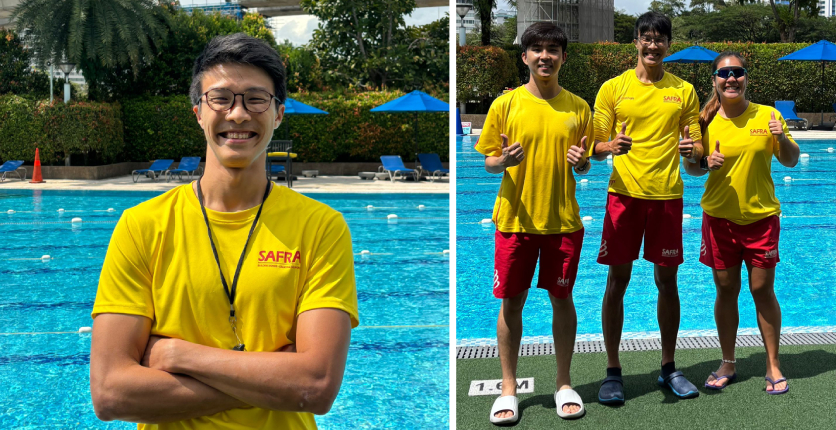
Jonathan, the lifeguard who saved Mr Tay’s life, has worked at SAFRA for about two years with a team of other qualified lifeguards. (Photo: Jonathan Chow)
Seconds That Made the Difference
Recognising the danger instantly, Jonathan sprang into action.
Later CCTV review showed that only about 40 seconds had passed between the moment Mr Tay suddenly submerged and the moment Jonathan reached him.
“I quickly radioed my fellow lifeguards for support and conducted the rescue,” he said.
Diving into the water, Jonathan pulled Mr Tay from the bottom of the pool and towed him to the side. Another swimmer nearby helped lift Mr Tay onto the pool deck.
But the situation was critical. Mr Tay was not breathing. Without hesitation, Jonathan began CPR.
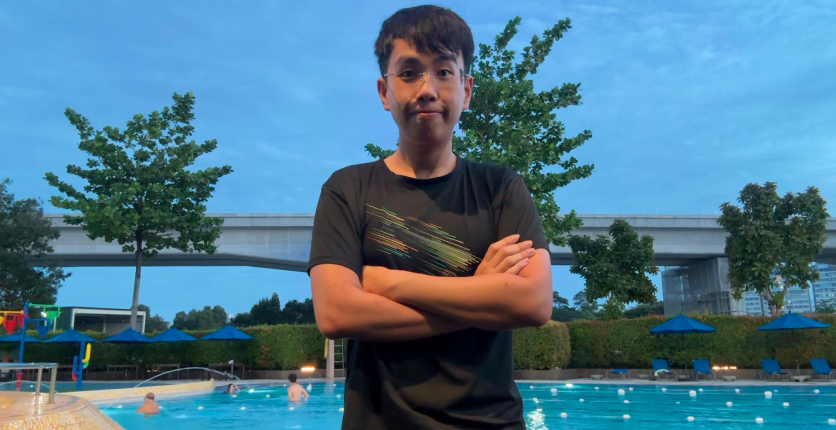
SAFRA member Zhen Hui was one of the swimmers who stepped forward to help revive Mr Tay during the near-drowning incident. (Photo: Zhen Hui)
A Community Steps Forward
The rescue effort quickly became a coordinated team response.
Among the swimmers that evening was Whey Zhen Hui, a SAFRA member who had recently completed his Master’s degree at the National University of Singapore. Zhen Hui had been swimming in another lane when he noticed something unusual.
“At first, it looked like Mr Tay might have been doing underwater breath-holding training,” he recalled. “But as seconds passed and he didn’t surface, and there were no bubbles, I realised something was wrong.”
He immediately alerted the lifeguard and helped bring Mr Tay to the surface.
On the pool deck, Zhen Hui stepped forward again — this time to assist with CPR.
“Zhen Hui courageously stepped forward to offer his assistance,” Jonathan said. “We performed two-man CPR together, alternating cycles of chest compressions.”
While the pair focused on resuscitation, the rest of the lifeguard team moved swiftly to support the effort.
Jonathan’s fellow lifeguards on duty that evening — Ho Ting Fang and Wesley Chan — called the ambulance, retrieved the Automated External Defibrillator (AED), cleared swimmers from the pool and managed the surrounding crowd.
“This is exactly what we train and rehearse for,” Jonathan explained. “When my teammates saw me enter the pool and heard the distress signal, they immediately carried out the critical steps.”
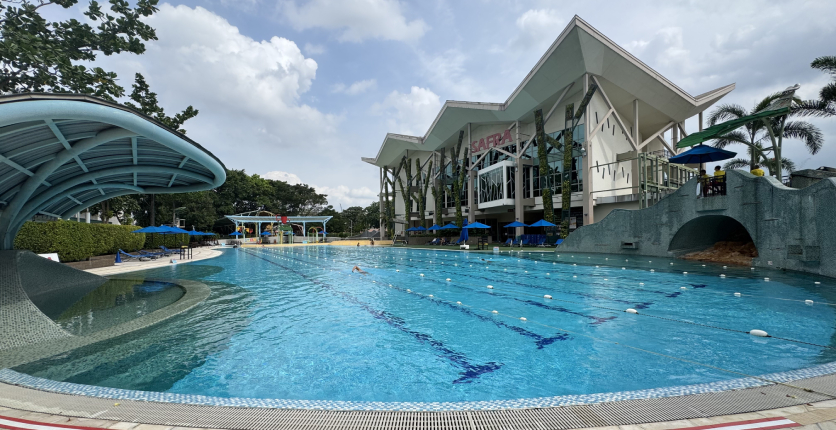
SAFRA Jurong swimming pool where the near-drowning incident and the courageous rescue happened. (Photo: SAFRA)
The Fight to Restart a Heart
For the next 15 minutes, the team worked tirelessly.
They performed repeated CPR cycles — 30 chest compressions followed by two rescue breaths — the recommended protocol for drowning victims.
The AED was attached. It advised two shocks.
Meanwhile, two responders alerted through the myResponder mobile app also arrived at the scene to assist. Together, the group continued the life-saving effort.
“During the rescue, I wasn’t thinking about much,” Jonathan shared. “I was just focusing on the step-by-step actions I had programmed myself to follow, and making sure my team carried out their roles.”
Then, just before paramedics arrived, something remarkable happened. Mr Tay regained his pulse and he began breathing again.
“When the paramedics took over, they confirmed that he had a pulse and was breathing on his own,” Jonathan said.
A Hidden Danger Revealed
At the hospital, doctors discovered the true cause of the incident.
Mr Tay had suffered a sudden cardiac arrest caused by three severely blocked arteries — 95%, 85% and 50% blocked.
The revelation stunned Mr Tay himself. “I thought I lived a healthy lifestyle,” Mr Tay reflected later. “I exercised a lot and slept well… but I ate unhealthily.” Despite being active, years of poor dietary habits had quietly taken their toll.
“I never liked to admit weakness,” he admitted. “And I didn’t adapt to the natural ageing process.”
Under the care of Professor Mark Chan from the National University Hospital, Mr Tay underwent emergency surgery to open the blocked arteries and insert stents.
The procedure was carried out swiftly. By midnight, he was already in the Intensive Care Unit. By the next afternoon, he was sitting up and eating lunch. Within two days, he was well enough to move to a normal ward. The only lingering discomfort came from rib pain caused by the CPR compressions that had saved his life.
The Power of Preparedness
When Jonathan later learned the medical cause of the incident, it confirmed what he had suspected. “It wasn’t surprising to me,” he said. “From the fact that the AED advised shocks, I suspected it might have been a heart-related condition.”
The experience reinforced the importance of vigilance. “Most days as a lifeguard are fairly routine and incident-free,” he explained. “The real challenge is maintaining a high level of focus even when nothing unusual is happening.”
That discipline is supported by regular training.
All SAFRA lifeguards are certified with the Bronze Medallion lifesaving certificate and CPR-AED licences. They also conduct frequent drills and scenario-based exercises to keep their skills sharp.
“This incident reinforced that emergencies are not a matter of if, but when,” Jonathan said. “We must remain disciplined and prevent complacency.”
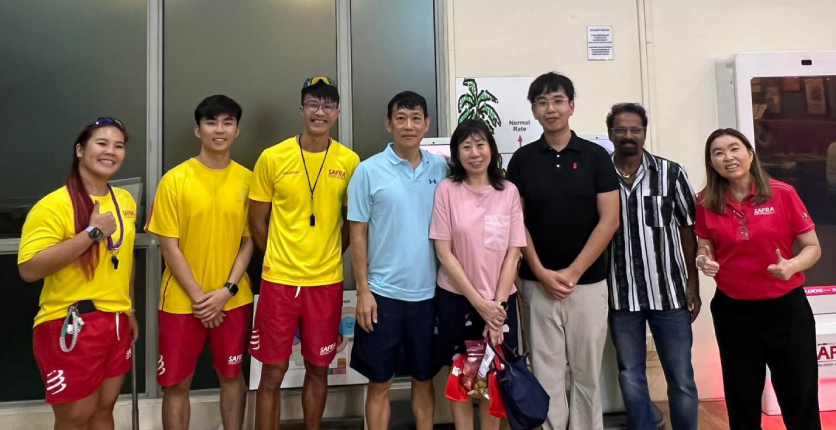
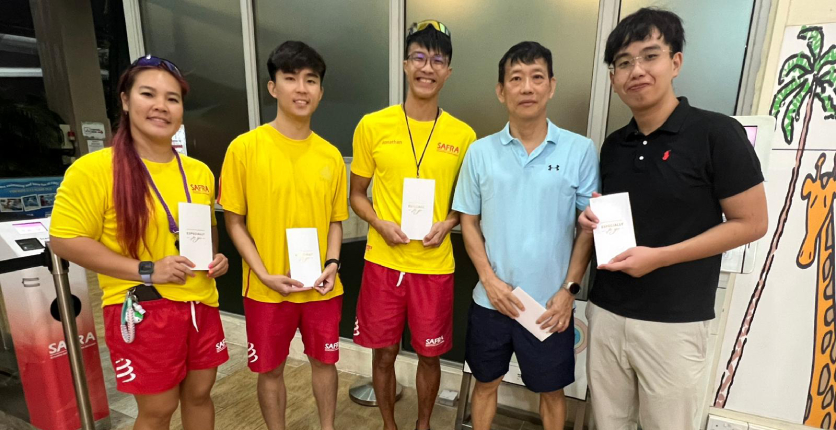
After recovering, Mr and Mrs Tay went back to meet and thank the lifeguard team and SAFRA member Zhen Hui together with the SAFRA Jurong team.
A Reunion Filled with Gratitude
Recently, Mr Tay and his wife returned to SAFRA Jurong Pool. This time, they were not there to swim. They had come to personally thank the people who saved his life.
For Jonathan and the lifeguard team, the reunion was deeply moving.
“They didn’t have to return to thank us personally,” Jonathan said. “But seeing Mr Tay so alert and energetic, and Mrs Tay so happy and full of smiles, was a powerful reminder that our preparedness and teamwork truly made a difference.”
Mrs Tay expressed heartfelt gratitude as well. She pointed out that if the cardiac arrest had happened somewhere else — at home or on the street — there might not have been trained responders or life-saving equipment nearby.
At the pool that night, however, every link in the chain of survival had held strong.
Courage in the Moment
For Zhen Hui, the experience left a lasting impression. “I felt a surge of strength and purpose at that moment,” he said of the rescue. “My CPR training and healthcare experience instinctively kicked in.”
He believes the most important lesson is that more people should learn CPR. “CPR is a life skill,” he said. “Courage in a fraction of a second can give someone a lifetime of tomorrows.”
A Second Chance
Today, Mr Tay’s recovery continues steadily.
He has resumed light exercise and is embracing a healthier lifestyle, including better dietary habits.
“A healthy life must include a healthy diet,” he said.
He also encourages people above 50 to consider preventive heart screening, such as calcium score tests that can detect plaque in the arteries.
Most importantly, the experience has changed how he views life. “I have accepted the ageing process,” he said with quiet wisdom. “I will enjoy the slower pace of life.”
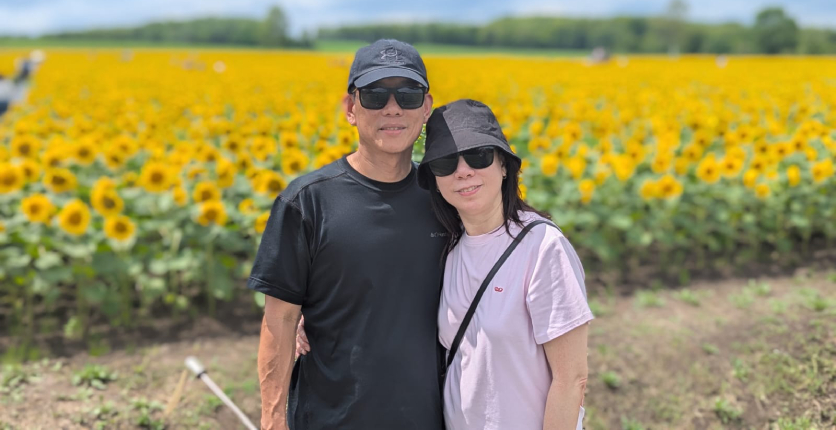
Mr Tay says he has accepted the ageing process and will endeavour to enjoy the slower pace of life from now on.
A Lesson for Everyone
The incident at SAFRA Jurong Pool serves as a powerful reminder for the community.
Hidden health conditions can exist even in active individuals. Quick intervention can mean the difference between life and death. And ordinary people — lifeguards, swimmers and bystanders — can become lifesavers when they step forward.
Reflecting on the rescue, Jonathan summed it up simply: “It made me proud to know that my training and work can have a very real, life-changing impact.”
Thanks to vigilance, courage and teamwork, what could have been a tragedy became something else entirely.
A story of courage.
A story of preparedness.
And for one man and his family — a story of a second chance at life.
You can also do your bit to take action and help save lives by registering as a Community First Responder via the myResponder App by the SCDF. Read more about and download the app here.
ALSO READ: Arm Yourself With Essential First Aid Basics | SAFRA
