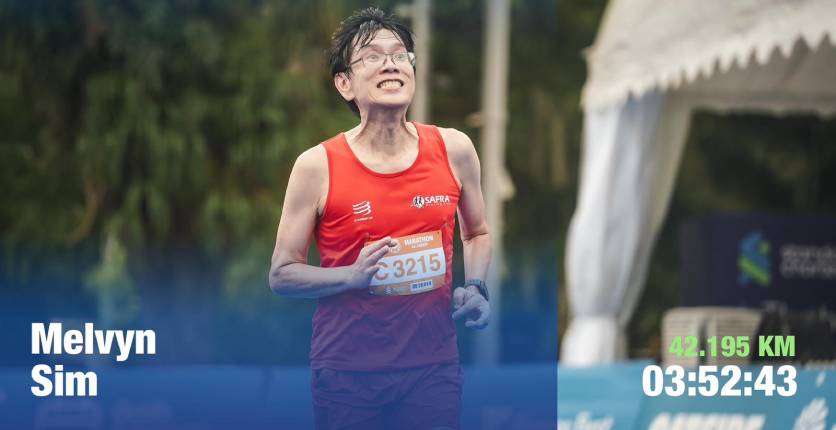
At 54, Melvyn Sim is used to thinking in probabilities, models and outcomes. A Chair Professor at the NUS Business School with a PhD from MIT, his professional life revolves around helping organisations and individuals make better decisions under uncertainty. But a few years ago, it was his own health that presented the most urgent optimisation problem of all.
“I’m Melvyn Sim, 54 years old, married with two kids,” he says matter-of-factly. “I studied at NUS and later did my PhD at MIT. For NS, I was posted to different units during reservist and I’ve since completed my reservist obligations.”
Up until this time, Melvyn has led a fruitful life. But it was the moment which his doctor delivered a stark diagnosis that would change his life forever.
Before joining SAFRA Running Club at Mount Faber (SRCMF), Melvyn describes his lifestyle as largely sedentary. Like many professionals juggling work, family and responsibilities, exercise slowly slipped down the priority list. The turning point came after he turned 50.
“I became obese, with my BMI exceeding 30,” he recalls. “Last year, at age 53, I went for a comprehensive medical screening and was diagnosed with type 2 diabetes. My blood pressure was moderately high, my cholesterol readings were poor. The doctors recommended medication alongside lifestyle changes.”
For Melvyn, this wasn’t just another health advisory, it was a reckoning. Instead of immediately starting medication, he made a deliberate request.
“I asked my doctor to give me three months to try lifestyle changes first, keeping medication as a last resort.”
That decision marked the start of a disciplined, structured and deeply personal journey, one rooted not in quick fixes, but in sustainability.
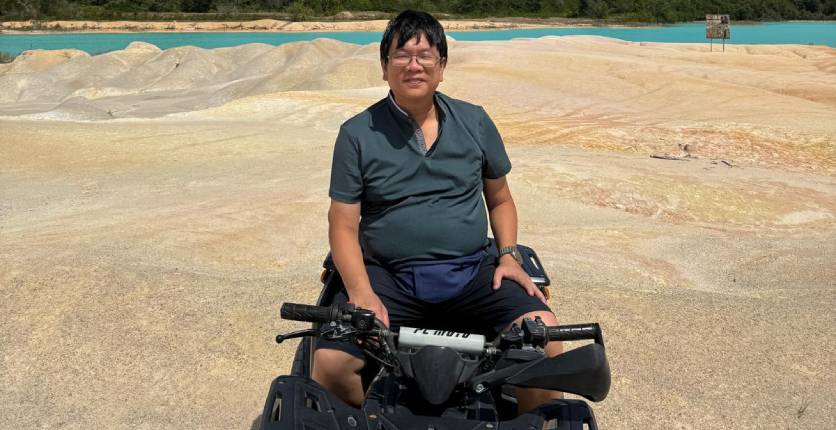
Over the next four months, Melvyn committed to a low-carbohydrate diet, intermittent fasting, occasional prolonged fasting, and modest walking. The results were dramatic.
“I managed to bring my BMI down to about 23,” he says.
But while the numbers were encouraging, Melvyn knew the approach had its limits.
“I knew deep down that this alone was unlikely to be sustainable. I needed regular exercise… not as a short-term intervention, but as something I could genuinely enjoy and commit to for the long haul.”
Once his weight came down, he began jogging. Yet, like many beginners, he quickly realised that motivation without structure rarely lasts.
“I knew I needed structure and community to stay consistent.”
That realisation led him to a friend who would unknowingly change his daily routine and trajectory.
A conversation with Man Wei, a seasoned marathon runner, proved pivotal. Man Wei introduced Melvyn to SAFRA Running Club at Mount Faber, which he joined in January.
“I am immensely grateful to him,” Melvyn says. “Through SRCMF, I found a community of runners who are deeply committed, almost obsessed in the best possible way, with staying fit and running.”
What started as an attempt to stay consistent soon became something far more meaningful.
“It’s rare in life that a single introduction changes your daily habits and, ultimately, your trajectory. Joining SRCMF did exactly that for me.”

Melvyn’s weight loss — between 20 to 30 kg over roughly a year — was never about aesthetics. The real objective was metabolic health.
“The diabetes diagnosis was the defining trigger,” he explains. “Beyond weight loss, the goal was to build metabolic flexibility, so that I could manage my condition sustainably rather than relying solely on strict dietary restrictions.”
Running became the anchor that tied everything together. Training was no longer optional or reactive; it became systematic and purposeful.
For someone who studies decision-making under uncertainty, intuition alone was never enough. Melvyn tracked everything.
“I closely monitored body weight, blood pressure, HbA1c, resting heart rate, inflammatory markers like hs-CRP, visceral fat, VO₂max, and my cholesterol profile.”
Over time, the data told a clear story: consistent improvement across almost all indicators.
One metric stood out above the rest.
“VO₂max is one of the strongest predictors of all-cause mortality,” he says. “At diagnosis, mine was in the low 20s, which was frankly alarming. Through consistent training, it has improved to around 50, which is very good for my age.”
The feedback loop was powerful. Train hard, see measurable gains, stay committed.
“That quantitative feedback reinforced everything I was doing.”

Training with SRCMF is not for the faint-hearted. Mount Faber and Telok Blangah Hill are defined by relentless climbs and punishing descents.
“The terrain is demanding, but that’s precisely what makes the training effective,” Melvyn says. “When fatigue sets in on the climbs, you’re forced to engage both physically and mentally.”
Mindful of injury and overtraining, Melvyn took a cautious, evidence-based approach. He underwent a Bruce treadmill stress test, achieving 17.1 METs (Metabolic Equivalent of Task) level, and received clearance from his doctor. A score of more than 10 METs indicates a healthy fitness level and is said to be excellent.
“That assurance gave me the confidence to push harder, knowing I was within safe limits.”
The result? Noticeable improvements in cardiovascular capacity — exactly what he set out to achieve.

SRCMF’s strength lies not just in its routes, but its people.
“There’s a wide range of runners with different fitness profiles,” Melvyn says. “You’re always surrounded by people stronger than you, as well as those on their own journeys.”
The trainers strike a delicate balance: encouraging, observant, and occasionally playful.
“They gently push you to go further, but they’re also quick to check in if they sense you’re pushing too hard.”
The camaraderie made all the difference.
“Despite the tough workouts, training is genuinely enjoyable. You never feel like you’re doing it alone.”
That sense of belonging spilled over into his personal life. Melvyn encouraged nearly ten people, including his wife, to join SRCMF. She went on to complete her first Standard Chartered Half Marathon in 2 hours and 22 minutes, a milestone achievement for her age group.

Like any long journey, there were plateaus, both physical and mental. It was the same for Melvyn’s fitness journey, but he found ways to cope.
“Fasting has been especially effective when weight loss plateaued,” Melvyn explains. “By avoiding refined sugars and simple carbs, I keep my glucose stable, which reduces hunger.”
Mentally, he adopts a philosophy that mirrors his academic work.
“I see myself as a ‘satisficer’ rather than a ‘maximiser’. I set challenging but achievable goals. Hitting them consistently builds confidence.”
Small wins, repeated over time, became the antidote to self-doubt.

Completing a marathon in under four hours is no small feat, especially for someone who started running seriously in his 50s.
Much of the preparation came from SRCMF’s long slow distance (LSD) runs at Sentosa, meticulously planned by trainer Raymond Keh, with hydration support from fellow members.
“I learned exactly what I could sustain. Holding 5:30 min/km for over 30 km gave me confidence.”
On race day, he went out slightly faster than planned. Up to 30 km, everything felt controlled. At 35 km, leg cramps struck… likely due to insufficient salt intake.
“I slowed to about 6:00 min/km but managed to hold it together.”
At the 36 km mark, SRCMF supporters appeared.
“That emotional lift was huge. It reminded me this wasn’t just an individual effort.”
Melvyn managed to cross the finish line in 3 hours and 53 minutes. Achievement unlocked!

As training intensified, Melvyn kept his approach to nutrition simple and sustainable.
“I adjusted carbs slightly before races, but I never tried to optimise excessively.”
He sees himself as a recreational runner, not a competitive one.
“Consistency, recovery and long-term health always come first.”
Social media shows medals and finish lines, but not the discipline behind them.
“Waking up early, week after week, for LSD runs was the hardest part during marathon training,” Melvyn admits. “That discipline mattered far more than any single workout.”
“Having a community that’s committed to training makes it much easier, and more enjoyable.”

Running with SRCMF transformed fitness from a personal goal into a shared lifestyle.
“We are social animals,” he says. “Doing this together builds accountability and motivation.”
Health is no longer about short-term fixes — it’s about balance, community and mental well-being.
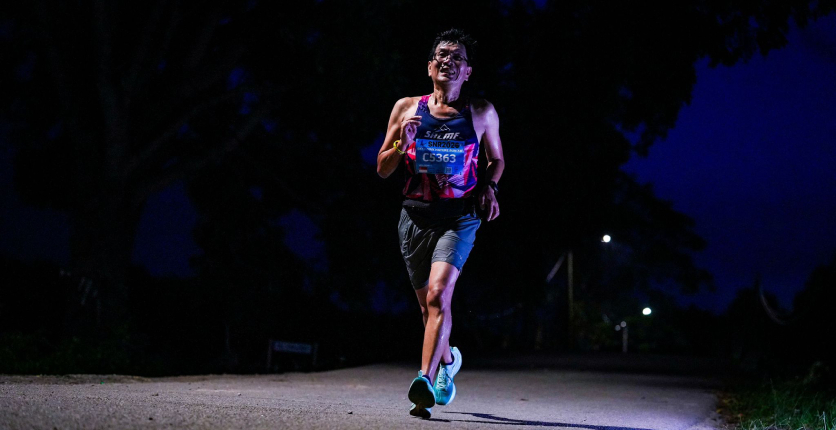
Melvyn is cautious about giving universal advice, but he offers hope.
“For those who are diabetic or pre-diabetic, improvement is possible. My HbA1c has stayed below 5.4 for over a year. Remission is not impossible.”
He says that his own experience suggests that there is a feasible path forward that people can explore and adapt to their own context, even though many doctors he spoke to says that remission is very unlikely.
And that knowledge, he believes, can be the most empowering thing.
Melvyn isn’t chasing endless personal bests.
“The goal is equilibrium — integrating running naturally into daily life.”
Giving back, encouraging others, and staying consistent matter more than shaving seconds off a timing chip.
“If my experience can help others start or stay on their journey,” he says, “that would be meaningful.”
And in that quiet, measured perspective lies the real victory — not just a sub-4 marathon, but a life decisively rerouted towards health.
If you are inspired by Melvyn and interested to join the SRCMF, visit Running Club | NSMen Portal Singapore | SAFRA for more information. SAFRA members pay $21.40 for a 2-year membership and for non-SAFRA members they pay $33.70.