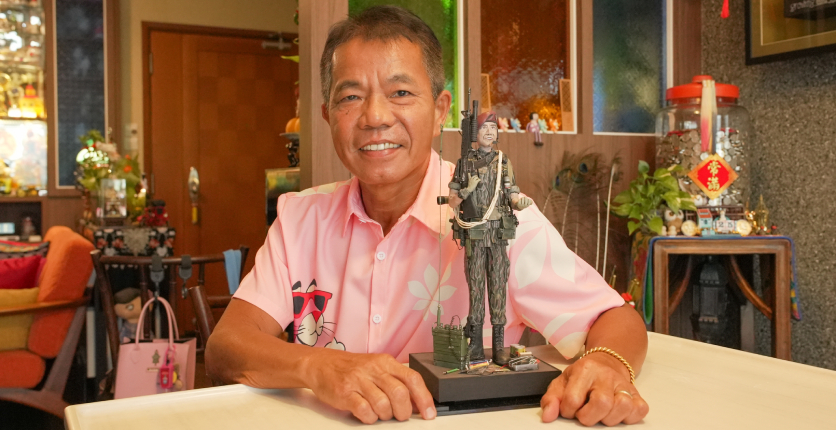
At 60, Wilfred Cheah isn’t slowing down, he’s zooming in… not at Zoom meetings but zooming in on the textures of old kopitiam floors, the weathered zinc roofs of kampong homes, the quiet magic of street wayang stages, and the everyday details that once defined Singapore life. Details many of us walked past. Details that are disappearing fast. Details Wilfred now rebuilds, lovingly and painstakingly, in miniature form.
A former SAF Commando, long-time interior designer, husband, father and now proud grandfather, Wilfred’s journey is a reminder that National Service doesn’t just shape soldiers. It shapes lives. And sometimes, artists.
“I do not make miniatures,” he says simply. “I create memories.”
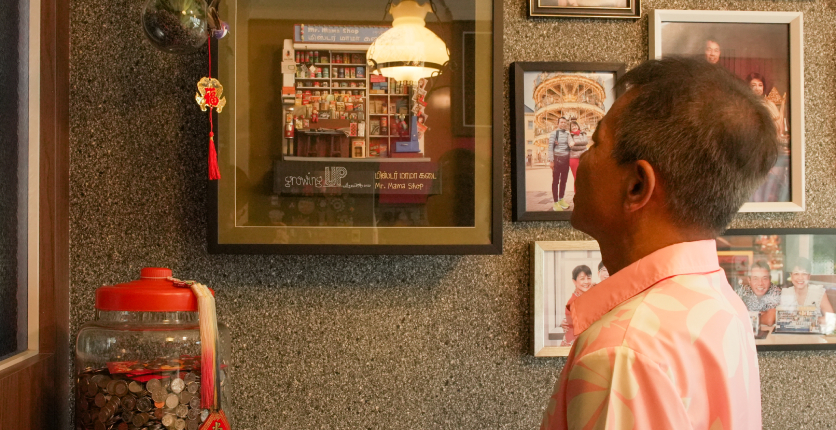
Wilfred Cheah is SG60 this year. He lives with his wife, while his only son has started his own family, making Wilfred a newly minted grandfather to a five-month-plus grandson. But rewind a few decades, and you’ll find a very different version of Wilfred.
Enlisted into the SAF Commandos in 1984, he stayed on as a regular for nine years until 1993, a period that would permanently define his mindset. After leaving the SAF, he pivoted into the architectural and interior design industry, where he spent 28 years learning, adapting and mastering his craft.
Armed with only an ‘O’ Level certificate and no formal art training, Wilfred taught himself everything, from manual drawings to computer graphic renderings, long before tutorials were a click away on YouTube.
Then, at 55, he made a decision many only dream about.
“I decided I had enough of the commercialised world,” he says. “It was time to slow down… and do what I truly loved.”
That love? Art.
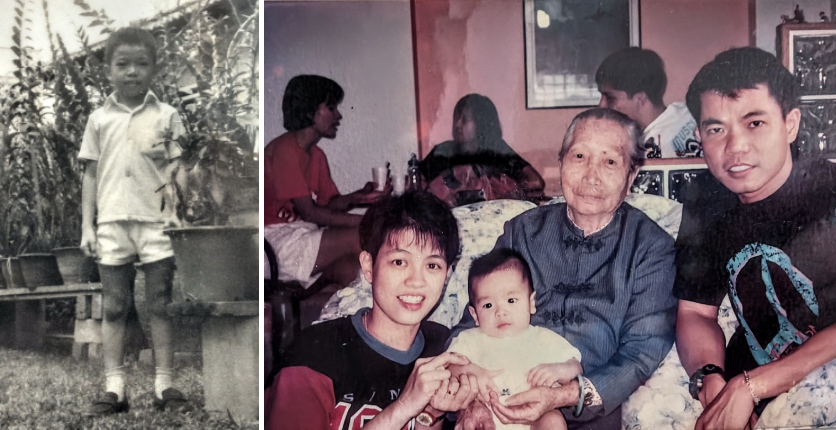
Wilfred’s artistic instincts didn’t appear overnight. They were forged in childhood… in a time when money was tight and imagination had to do the heavy lifting.
“My dad was the sole breadwinner. We couldn’t afford toys,” he recalls. “So I made them.”
Using whatever he could find — scrap paper, cardboard, discarded materials — young Wilfred built his own playthings. What began as necessity quietly became instinct. That instinct never left.
“Scarcity forces creativity,” he reflects. “When you have limitations, your imagination works harder.”
Decades later, that same philosophy guides his miniature art. Almost everything he creates is handmade using recycled or everyday materials, a conscious choice rooted in both practicality and principle.
“Art materials aren’t cheap. And this was supposed to be a retirement hobby,” he laughs. “So I went back to what I knew… making something out of nothing.”
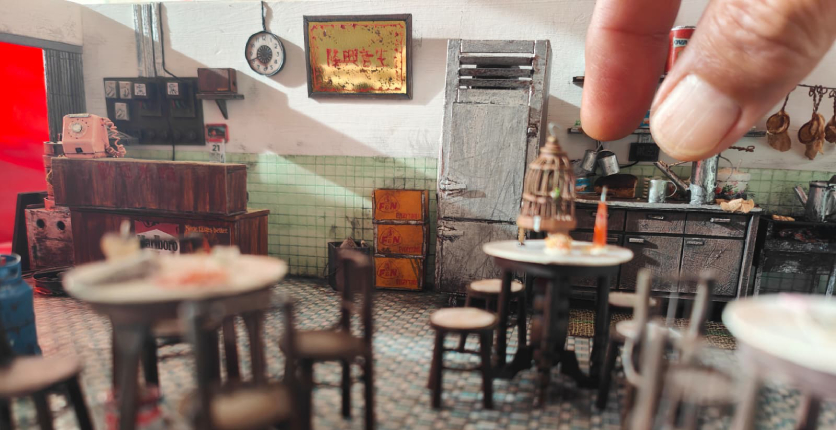
Scroll through Wilfred’s Instagram account and you’ll find tiny worlds frozen in time: old HDB corridors, neighbourhood shops, kampong scenes, street wayang performances. For many viewers, the reaction is instant — smiles, silence, sometimes even tears.
For Wilfred, these aren’t just artistic choices. They’re deeply personal.
“My artworks are my childhood,” he says. “Especially my time with my grandmother.”
She was the constant in his early life, the one who brought him along to markets, performances, neighbourhoods and everyday Singapore moments that no longer exist in the same way.
“These pieces are like time capsules,” he explains. “People tell me they remember things they didn’t even know they remembered.”
The nostalgia hits harder knowing most of his works are created using discarded materials, giving old objects new life, just as he resurrects old memories.
“Singapore changes very fast. Some places are here today, gone tomorrow,” he says. “If we can’t preserve everything in real life, maybe we can preserve the feeling.”
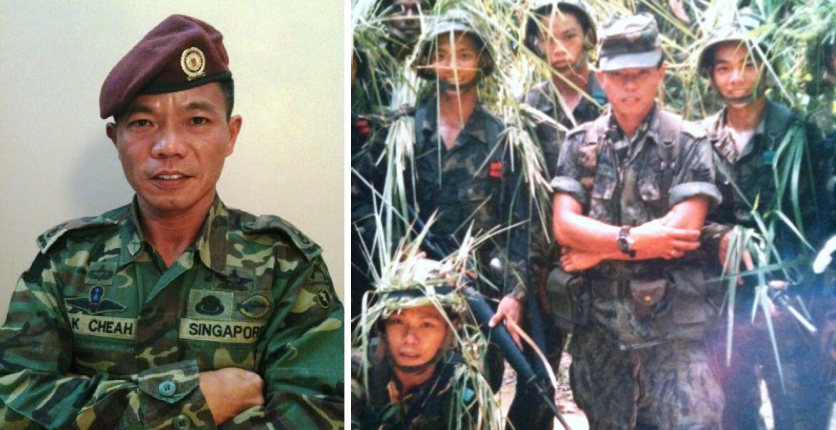
Wilfred doesn’t romanticise his time as a Commando, but he credits it for shaping everything that followed.
“We were expected to move further, carry heavier, fight harder and be self-sufficient,” he recalls. “There was no external support.”
In the early SAF days, equipment was basic and one-size-fits-all. Commandos learned to improvise, adapt and overcome, modifying gear to suit mission needs. That mindset never left him.
“When things get tough, it’s not just physical. It’s mental,” he says. “The job has to be done — down to the last man.”
Today, that same discipline shows up in his art. When faced with technical challenges, Wilfred experiments relentlessly: testing materials, redoing sections, scrapping parts entirely if needed.
“No compromise,” he says. “I redo until I pass my own quality control.”
Tough times don’t last; tough men do. The uniform may be gone, but the values remain.
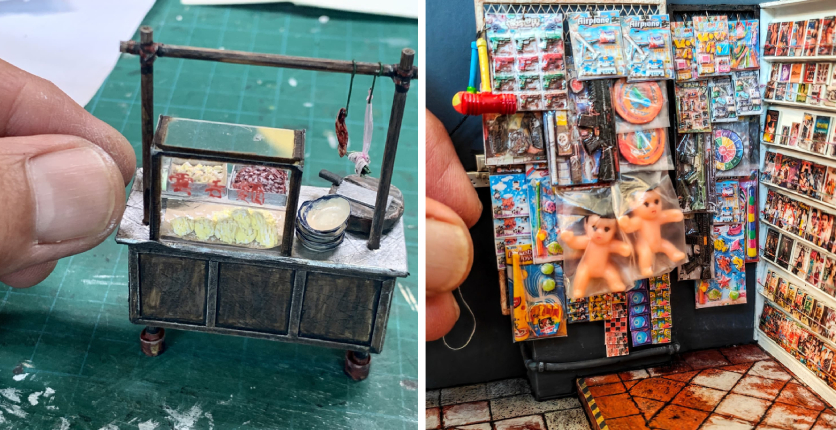
Wilfred’s creative process is as methodical as it is intuitive, a hybrid of designer logic and artist instinct.
His 28 years in interior design taught him scale, proportion and detail — skills that now translate seamlessly into miniature form.
He starts with photographs — studying doors, windows, people — then scales everything mathematically before deciding how large the final piece should be. Larger buildings mean smaller scales; portability is key.
“I want my works to fit into lifts and cars,” he says with a grin.
For older locations, Google searches help reconstruct lost architecture. For deeply personal pieces, memory fills the gaps, sometimes painfully, sometimes joyfully.
He sketches simple line drawings, marks dimensions, and builds from the inside out — a crucial detail many don’t consider.
“If you build outside first, your hand can’t fit in later,” he explains. “Planning is everything.”
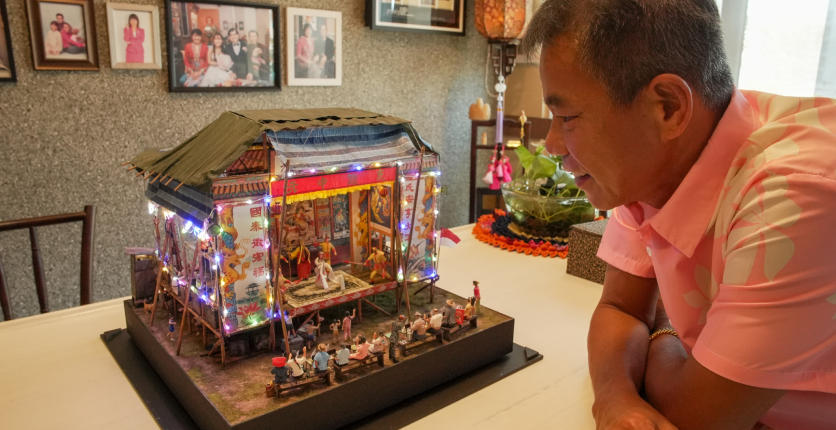
Ask Wilfred which piece was the most technically challenging, and he pauses.
“All of them,” he says honestly.
Every project starts from zero. Every photo reveals a problem area that demands planning, patience and experimentation. Often, the most time-consuming method turns out to be the right one.
“The difficult part is usually the best part,” he reflects. “That’s where the satisfaction comes from.”
Still, one piece stands above the rest.
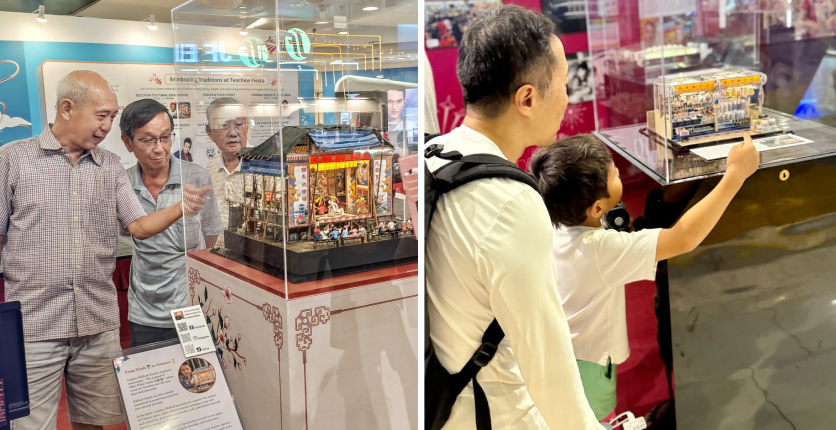
Among all his works, Wilfred’s street wayang miniature holds the deepest emotional weight. “It brought back so many childhood memories,” he says softly. “Playing around the stage. Watching performers with my grandma.”
He remembers the painted faces, elaborate costumes, daring acrobatics… everything except the singing, which he admits he never quite understood.
While building it, memories flooded back. Time folded in on itself. “I could still feel granny’s presence,” he says.
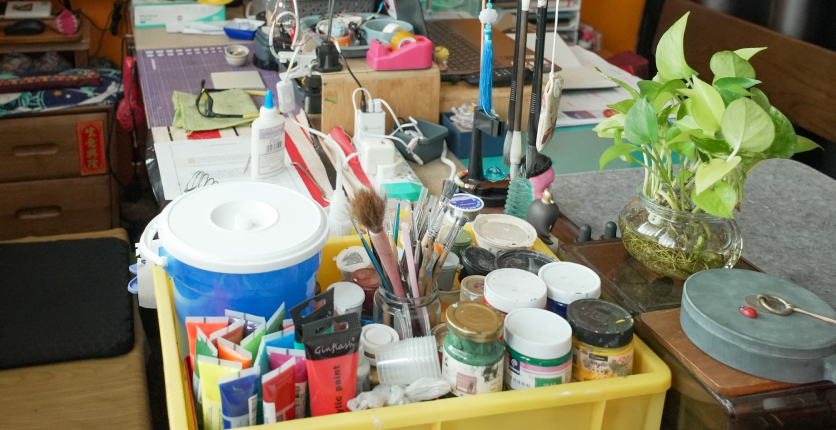
Wilfred doesn’t chase tears… but he believes emotion is essential.
“When I create for myself, it’s always childhood,” he explains. “Without photos, I squeeze every drop from memory.” That emotional honesty transfers to the audience. Viewers see themselves — their parents, grandparents, childhoods — reflected in tiny scenes.
“This became my principle,” he says. “Each artwork must tell a story emotionally.” Like cooking, he believes the maker’s mindset shapes the outcome. “A happy cook makes better food,” Wilfred laughs.
Leaving a stable design career wasn’t easy for him, but it was necessary. “I wanted to hand over to younger minds,” Wilfred says. “And slow down.”
In 2020, he committed fully to miniature art. embracing uncertainty in exchange for meaning. Today, most of his works are commissioned, with personal projects carefully scheduled in between.
Those interested in commissioning him can reach out via Facebook or Instagram. He requests photo references where possible, or detailed conversations when memories must substitute images. Sometimes, creative discretion is unavoidable.
Wilfred defines success differently. “Most people set success at the final product,” he says. “I set mine in small stages.”
Completing a difficult section. Finishing a day’s schedule. Solving one problem. “These are my daily successes,” he explains. “They accumulate.”
For Wilfred, the journey matters more than the destination.
Wilfred hopes that his art will be able to spark conversations, especially between generations.
During exhibitions, he watches older visitors light up, explaining scenes to younger family members. That, to him, is legacy.
“With technology and AI, many old things became obsolete,” he says. “I want younger generations to understand how we lived.”
Singapore may move fast, but memory doesn’t have to disappear. “My miniatures are another way of preserving progress,” he says. “In smaller scale.”
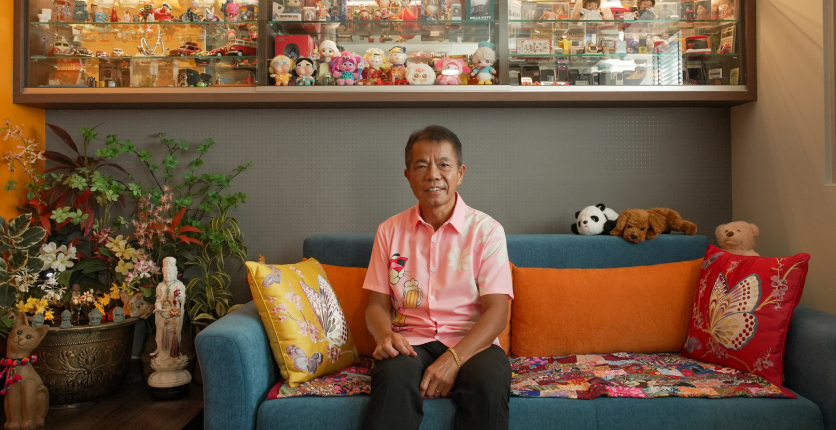
Wilfred leaves readers with one final thought, especially fellow NSmen: “Some still say NS is a waste of time,” he says. “But reflect properly and you’ll realise that the discipline, responsibility and mindset can apply everywhere.”
For him, even Sun Tzu’s Art of War still guides modern business. “The trick is to start moving,” he adds. “Dreams stay dreams if you don’t start.”
You may stumble. You may restart. But movement leaves footprints. “And every footprint,” Wilfred says, “is part of your success.”